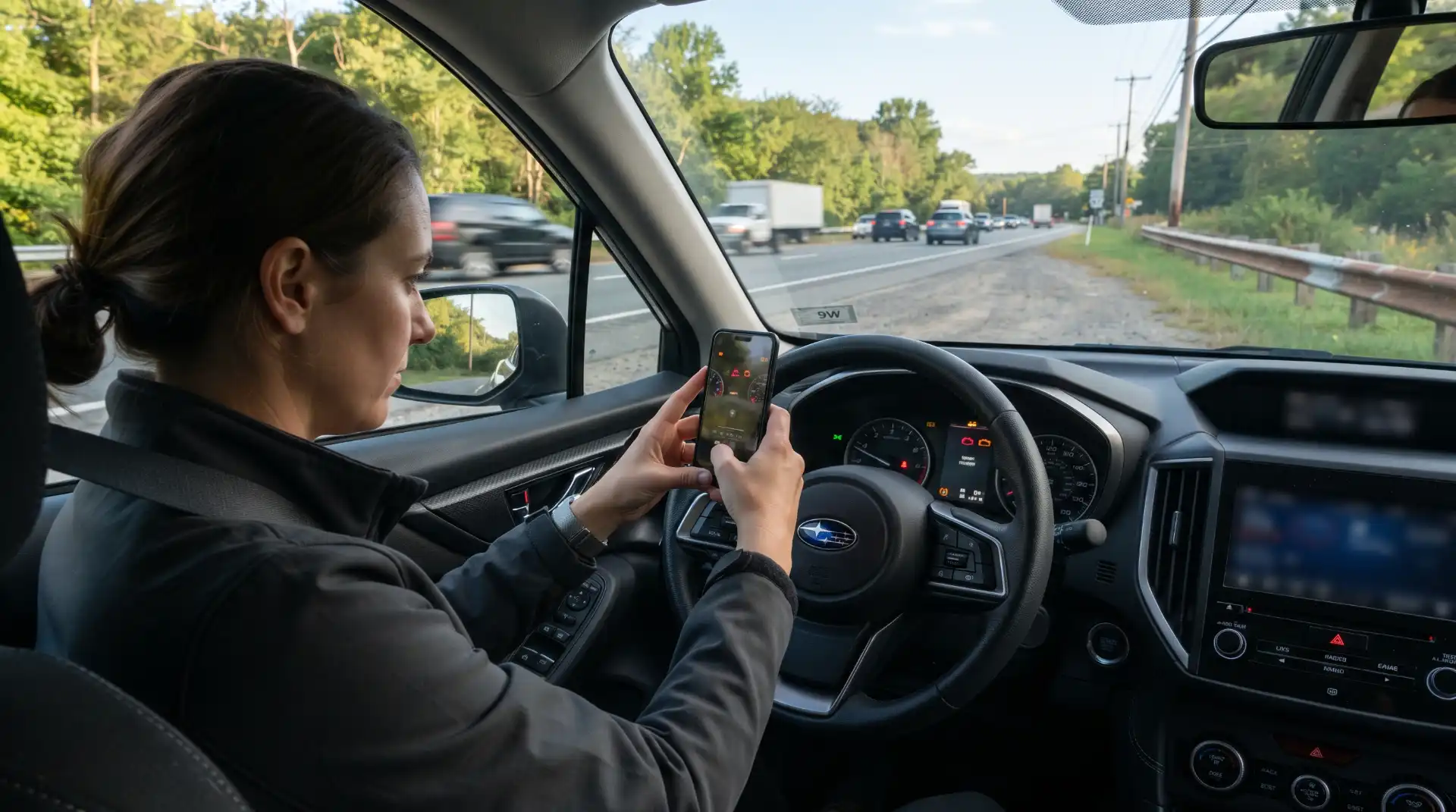

Drowsy driving does not always get the same attention as drunk driving or distracted driving, but it can be just as dangerous. A tired driver may have slower reaction time, poor judgment, tunnel vision, and difficulty staying in the correct lane. On a two-lane road, that combination can quickly become catastrophic. When a sleepy driver drifts over the center line, fails to correct in time, or nods off completely, the result may be a devastating head-on collision.
Head-on crashes are among the most severe traffic accidents in the United States because the force of impact is often intense, especially when both vehicles are moving at speed. Victims may suffer traumatic brain injuries, spinal damage, broken bones, internal injuries, or long-term emotional trauma. When fatigue plays a role, proving exactly what happened can also be more challenging than in other types of crashes. Unlike alcohol impairment, there is no quick roadside test for drowsiness. That means liability often depends on piecing together warning signs, driver behavior, and supporting evidence.
If you have already explored our article on Wrong-Way Driving Crashes: Why They Cause So Many Head-On Collisions in 2026, you know that even a momentary lane error can have life-changing consequences. Drowsy driving cases are similar in one important way: they often begin with a lapse in attention that lasts only a few seconds, yet those few seconds can destroy lives.
Why Drowsy Driving Is So Dangerous
Driving safely requires constant mental engagement. A person behind the wheel must observe traffic, monitor speed, anticipate hazards, keep proper lane position, and respond to sudden changes in road conditions. Fatigue affects nearly every one of those tasks. A tired driver may feel confident enough to keep going, but the body and brain often tell a different story.
Sleep deprivation can reduce alertness, impair concentration, and lengthen reaction time. Even before a driver actually falls asleep, fatigue may cause “microsleeps,” which are brief episodes of inattention that may last only a few seconds. On an open road, a vehicle can travel a surprising distance in that short time. If the road curves, traffic slows, or a center line is crossed, a major collision can happen before the driver realizes what is wrong.
Head-on collisions are especially common in fatigue-related crashes because tired drivers tend to drift rather than make deliberate evasive moves. Instead of braking hard or swerving away from danger, they may continue forward while gradually leaving their lane. That is one reason sleepy driving can be so deadly on rural highways, late-night commuter routes, and long stretches of roadway with limited lighting.
The National Highway Traffic Safety Administration warns that drowsy driving is a serious safety problem, and the Centers for Disease Control and Prevention also emphasizes that insufficient sleep can make drivers less able to respond safely to traffic conditions. These sources are helpful not only for prevention, but also for building a strong educational and evidentiary foundation in a claim.
Common Warning Signs of Drowsy Driving
One of the most frustrating aspects of fatigue-related crashes is that many warning signs appear before the collision. Drivers often have an opportunity to pull over, switch drivers, rest, or avoid the road entirely. Unfortunately, many people underestimate how impaired they are.
Some of the most common warning signs include:
- Frequent yawning or blinking
- Heavy eyelids or trouble keeping eyes open
- Difficulty remembering the last few miles driven
- Missing exits, turns, or traffic signs
- Drifting out of the lane or onto the shoulder
- Hitting rumble strips
- Inconsistent speed or delayed braking
- Nodding off, even for a moment
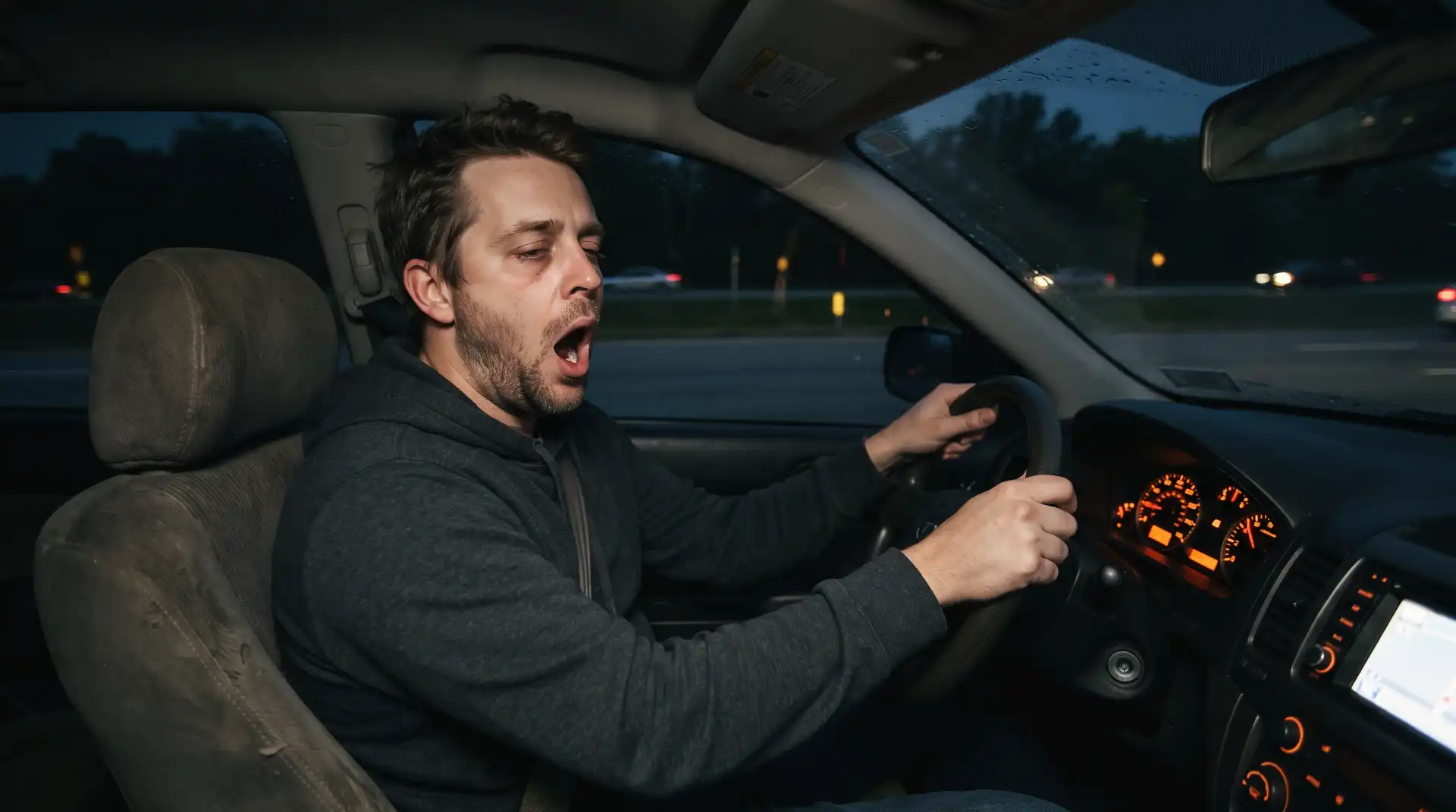
These signs matter because they can become evidence later. For example, a passenger might testify that the driver was yawning repeatedly or weaving before the crash. A witness from another vehicle may report seeing a car wander over the center line. A driver’s own statements at the scene, such as “I was exhausted” or “I think I dozed off,” can also be highly relevant.
Fatigue is not limited to overnight driving, either. It can affect people returning from long work shifts, parents caring for young children, commercial drivers under schedule pressure, college students on road trips, and anyone driving after too little sleep. Shift workers, medical professionals, delivery drivers, and truck drivers may face especially high risk when they spend long hours on the road or work irregular schedules.
How Drowsy Driving Leads to Head-On Collisions
Many fatigue-related crashes involve lane departure. A tired driver may slowly drift left of center on a two-lane highway, particularly where there is little traffic, poor lighting, or a long straightaway that creates a false sense of security. In other situations, the driver may overcorrect after drifting, lose control, and crash head-on with an oncoming vehicle.
This danger becomes greater in areas where drivers already face reduced margins for error. Narrow roads, construction zones, mountain routes, and undivided highways leave less room to recover. A fully alert driver might notice an approaching curve or an oncoming car and correct in time. A fatigued driver may not process the same information quickly enough.
There is also a psychological component. Drowsy drivers often believe they can “push through” tiredness by opening a window, turning up the radio, or drinking coffee. Those steps might create a temporary sense of alertness, but they are not reliable substitutes for actual rest. When the brain is exhausted, the decline in attention may be more severe than the driver realizes.
Fatigue can combine with other risk factors too. A person who is sleepy and also using a phone, speeding, taking medication, or driving in poor weather may be even more likely to cause a head-on collision. If weather and visibility also played a role, you may want to connect readers to your internal article on How Nighttime Glare and Sun Glare Contribute to Severe Collisions for additional context.
Who May Be Liable After a Drowsy Driving Head-On Crash?
In many cases, the primary liable party is the fatigued driver. Under general negligence principles, every driver has a duty to operate a vehicle with reasonable care. A person who continues driving despite obvious fatigue, drifts into oncoming traffic, or falls asleep behind the wheel may be found negligent because a reasonable driver would have recognized the danger and stopped.
However, the analysis does not always end there. Depending on the facts, other individuals or entities may also share responsibility.
The Driver
The individual driver is often the starting point in any claim. Evidence may show that the person had been awake for an extended period, ignored signs of fatigue, or admitted to being too tired to drive. If the driver crossed the center line or caused a frontal collision without another clear explanation, fatigue can become an important theory of liability.
An Employer
If the driver was working at the time of the crash, an employer may be liable under agency or respondeat superior principles. This issue often arises in cases involving delivery drivers, rideshare activity, company vehicles, or employee travel between job sites. If a company pressured a worker to meet unrealistic deadlines, failed to monitor rest, or encouraged unsafe scheduling, those facts could strengthen the claim.
Commercial trucking cases may involve additional evidence related to hours-of-service compliance. The Federal Motor Carrier Safety Administration sets hours-of-service rules for many commercial drivers, and violations of those rules can become key evidence in a fatigue-related collision.
The Vehicle Owner
In some cases, the owner of the vehicle may also face exposure under theories such as negligent entrustment if they knowingly allowed an unsafe or unfit driver to operate the car. This is more fact-specific, but it can matter where a family member, employer, or fleet owner knew the driver had a history of unsafe conduct or exhaustion-related driving.
Other Contributing Parties
Although fatigue may be the main cause, other contributing factors should still be examined. Poor road design, inadequate signage, mechanical defects, or unsafe vehicle conditions might worsen the crash or affect how liability is divided. In a serious case, a thorough investigation should consider every potential cause rather than assuming the issue begins and ends with one driver.
For readers who want a broader foundation on fault analysis, you can naturally direct them to How to Prove Liability in a Head-On Car Accident Case and Understanding Insurance Claims After a Head-On Collision.
Why Proving Drowsy Driving Can Be Difficult
Fatigue cases are not always straightforward. After a crash, the at-fault driver may deny being tired. Police may document lane departure but not specifically identify drowsiness as the cause. Unlike a DUI investigation, there is often no chemical test that confirms fatigue. As a result, these claims are frequently built through circumstantial evidence.
That does not mean the case is weak. In fact, many strong claims rely on a combination of details that point clearly to exhaustion. The key is gathering those details quickly before they disappear.
Insurance companies may try to characterize the collision as a simple accident, a momentary mistake, or an unavoidable emergency. They may argue there is no direct proof that the driver was sleepy. That is why early investigation matters. The more evidence you preserve, the harder it becomes for an insurer to dismiss the role of fatigue.
Evidence That Can Help Prove Fatigue and Liability
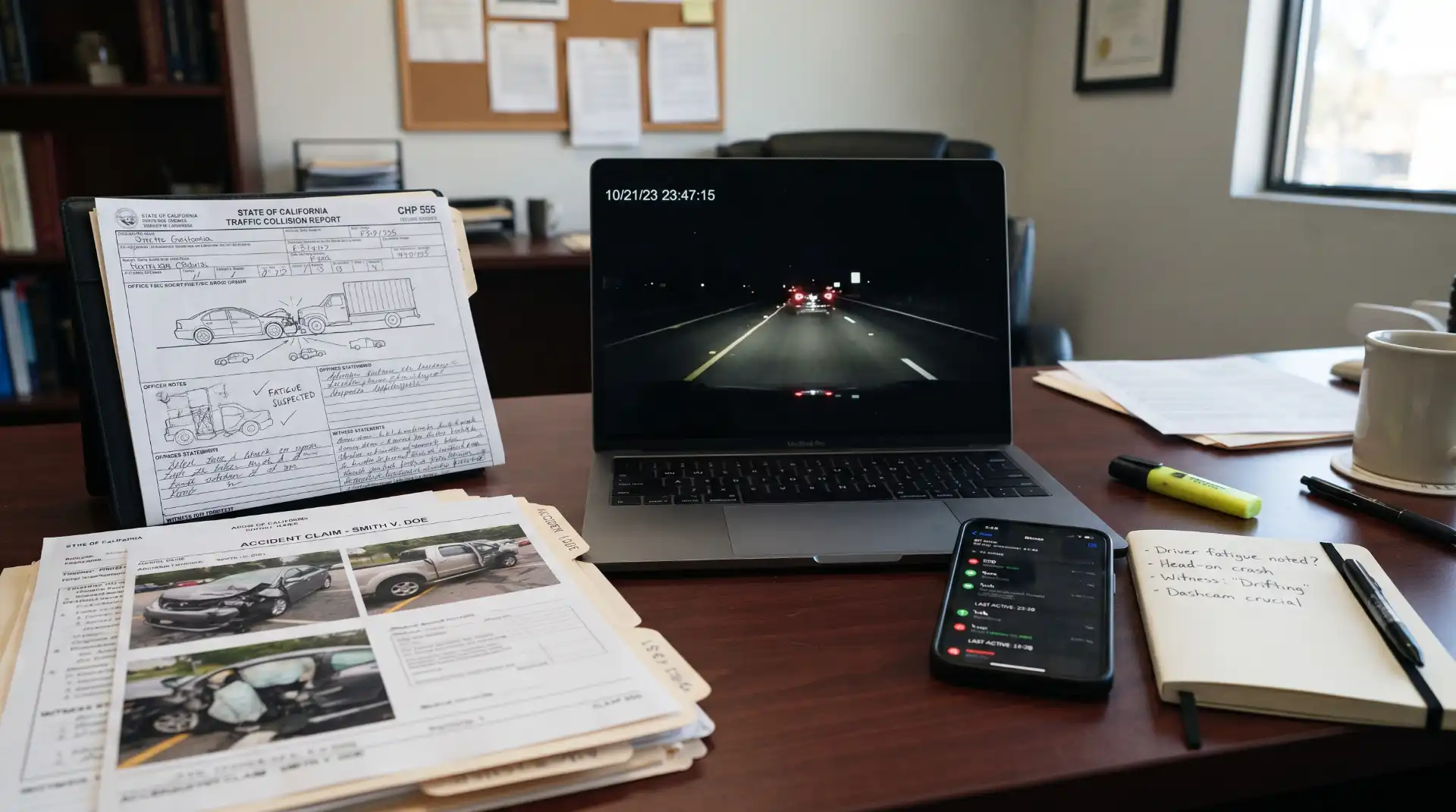
The best drowsy driving cases are built from layers of evidence. Each piece may not be conclusive by itself, but together they can paint a convincing picture.
Police Reports and Scene Documentation
The police report often provides the first summary of what happened. It may note lane position, absence of skid marks, the driver’s statements, witness observations, road conditions, and whether the vehicle crossed into oncoming traffic. Photos of the scene may also show a path of travel consistent with drifting rather than evasive maneuvering.
Witness Statements
Independent witnesses can be extremely valuable. Another motorist may have seen the vehicle weaving or gradually moving over the center line. A passenger may describe the driver’s yawning, nodding off, or repeated complaints about being exhausted. Friends, coworkers, or family members may also provide useful context if they knew the driver had been awake for a long time or had just completed an unusually demanding schedule.
Dashcam, Surveillance, and Nearby Video
Video footage can be powerful in head-on crash cases. Dashcams, business security cameras, highway cameras, and residential surveillance systems may capture the vehicle’s lane movement or the seconds before impact. A visual record showing a slow uncontrolled drift can support a fatigue theory far more strongly than a general statement that the driver “lost control.”
Event Data Recorder and Vehicle Data
Many newer vehicles store limited crash-related information through event data recorders, sometimes called black boxes. Depending on the vehicle and circumstances, this data may show speed, braking, steering input, and other pre-crash activity. If the data shows little or no braking before impact, that may support a theory that the driver was inattentive or asleep.
Advanced driver-assistance systems may also preserve useful clues. Lane departure warnings, driver monitoring features, and collision alerts can sometimes shed light on what the vehicle detected before the crash. For broader consumer safety context, readers may also appreciate your internal article on Top 5 Safety Features to Look for in 2025 Vehicles to Avoid Head-On Collisions.
Phone, GPS, Toll, and Digital Timeline Evidence
Digital evidence can help reconstruct the driver’s movements and schedule. GPS history, toll records, fuel receipts, app timestamps, rideshare logs, delivery records, and location data may show how long the driver had been on the road. If the crash occurred after many hours of continuous travel, that timeline can support an inference of fatigue.
Phone records can also matter, not only to rule out distraction, but to reveal whether the driver was awake at unusual hours before the crash. For example, messages or app use late into the night, followed by an early morning drive, may support a claim that the person was operating the vehicle with inadequate sleep.
Employment and Scheduling Records
When a crash involves a worker or commercial driver, time records, dispatch logs, delivery schedules, and employer communications may be critical. They can show whether the driver was under time pressure, had worked an extended shift, or may have violated company policies or federal rules related to rest.
Medical and Prescription Information
Some fatigue cases also intersect with medical conditions such as sleep apnea, insomnia, or medication use that may cause drowsiness. This issue must be handled carefully, but it may become relevant if a driver knew or should have known that a health condition or prescription affected their ability to drive safely.
What To Do After a Drowsy Driving Head-On Collision
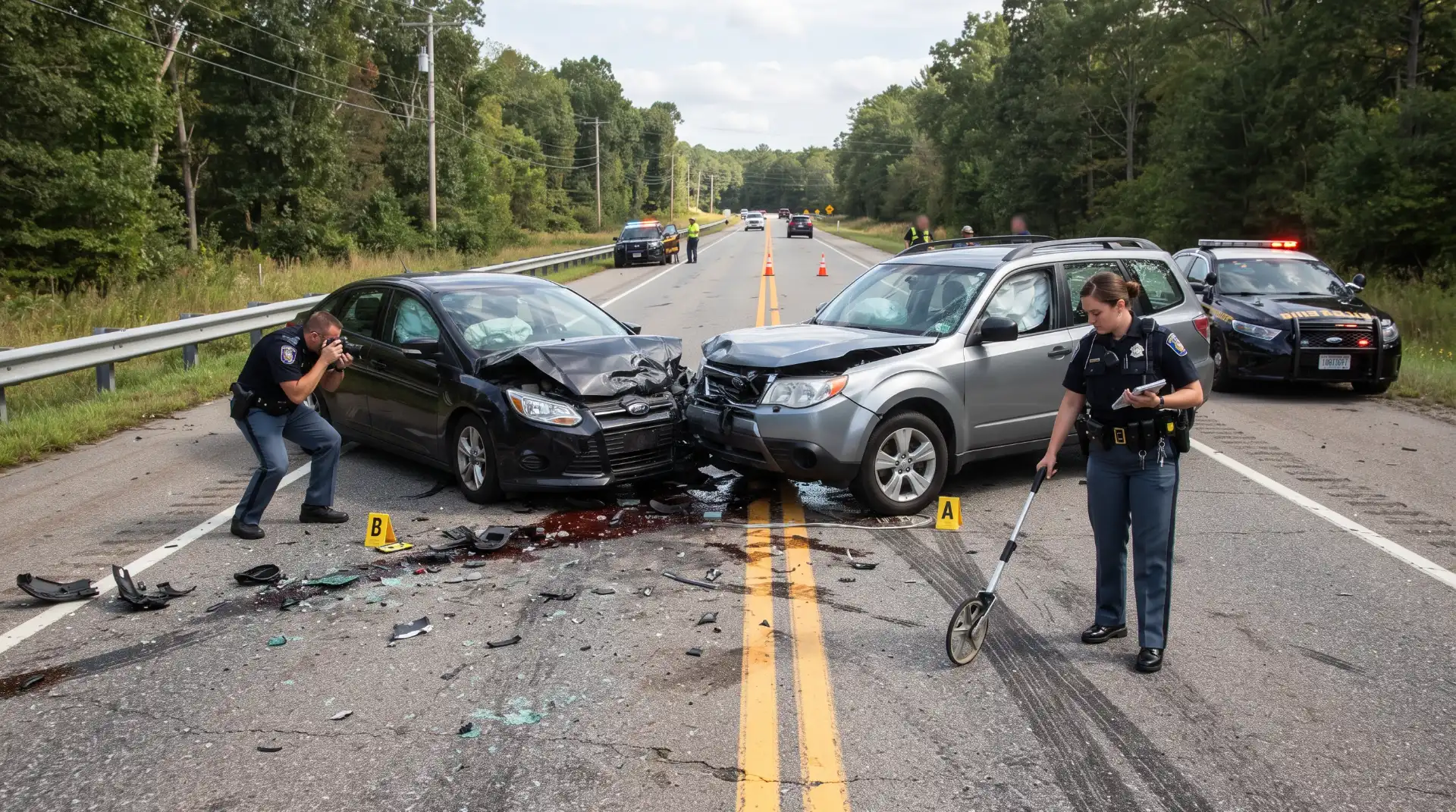
If you are involved in a head-on crash and suspect the other driver was fatigued, your actions in the hours and days after the collision may significantly affect the claim. The first priority is always emergency care and personal safety, but evidence preservation matters too.
Try to document what you observed as soon as possible. Did the driver appear groggy, confused, or sleepy? Did they admit they had been driving all night? Did witnesses mention weaving or drifting? Those details can fade quickly if not recorded.
It is also wise to preserve vehicle damage photos, dashcam footage, contact information for witnesses, and copies of any crash report. In serious cases, sending preservation requests for vehicle data, employment records, or surveillance footage may be necessary. The sooner these steps are taken, the better the chances of keeping important evidence from disappearing.
Medical records matter as well. Head-on crashes often cause severe injuries that require immediate and ongoing care. Consistent treatment not only protects health, but also helps document the full extent of harm caused by the collision.
How Insurance Companies May Defend These Cases
Insurers often challenge fatigue claims by arguing there is no direct proof of drowsiness. They may say the crash was caused by distraction, weather, an animal in the road, mechanical trouble, or a simple error in judgment. In some cases, they may even suggest that the injured person shares some blame for failing to avoid the collision.
That is why the most persuasive cases do more than accuse the other driver of being tired. They connect the evidence logically. A vehicle drifts across the center line. There are no skid marks. The driver had been awake for an extended period. Witnesses observed yawning or weaving. Work records show a long shift. Video shows delayed reaction. Together, those facts create a stronger narrative than any single piece could alone.
Insurance adjusters also examine damages closely in severe head-on collision cases because the potential exposure may be substantial. Medical expenses, lost income, long-term care needs, pain and suffering, and future limitations may all be part of the claim. That is another reason to keep treatment records, bills, and documentation of recovery challenges organized from the start.
Can Technology Help Prevent These Crashes?
Modern vehicles increasingly include features designed to reduce crash risk, such as lane departure warnings, lane-keeping assist, forward collision warning, and driver attention monitoring. These systems can help, but they are not substitutes for a well-rested driver. A safety feature may provide an alert, but it may not prevent a crash if the person behind the wheel is too tired to respond.
Technology is best understood as a backup layer, not a cure for fatigue. The safest approach is still simple: get enough sleep, avoid driving when exhausted, take breaks during long trips, and stop immediately when warning signs appear.
Final Thoughts
Drowsy driving is often underestimated because it does not always look dramatic before a crash. There may be no speeding, no aggressive lane change, and no visible impairment until the vehicle slips over the center line and the collision occurs. But the consequences can be every bit as devastating as other forms of negligent driving.
When fatigue contributes to a head-on collision, liability may be proven through a careful combination of scene evidence, witness statements, vehicle data, digital timelines, and scheduling records. Because there is rarely one single “fatigue test,” success often depends on building a complete and credible story from the available facts.
For site visitors trying to understand the bigger picture, this topic also connects naturally with your related resources on wrong-way driving, liability, insurance claims, and vehicle safety technology. Together, those articles help readers understand not only how head-on collisions happen, but also how responsibility may be established after a serious crash.
Above all, drowsy driving is preventable. Recognizing the warning signs, respecting the need for rest, and taking fatigue seriously can save lives. And when a tired driver causes a catastrophic head-on collision, strong evidence can make the difference in proving what really happened.